What does a beginner need to start forex trading and how does the market actually work?
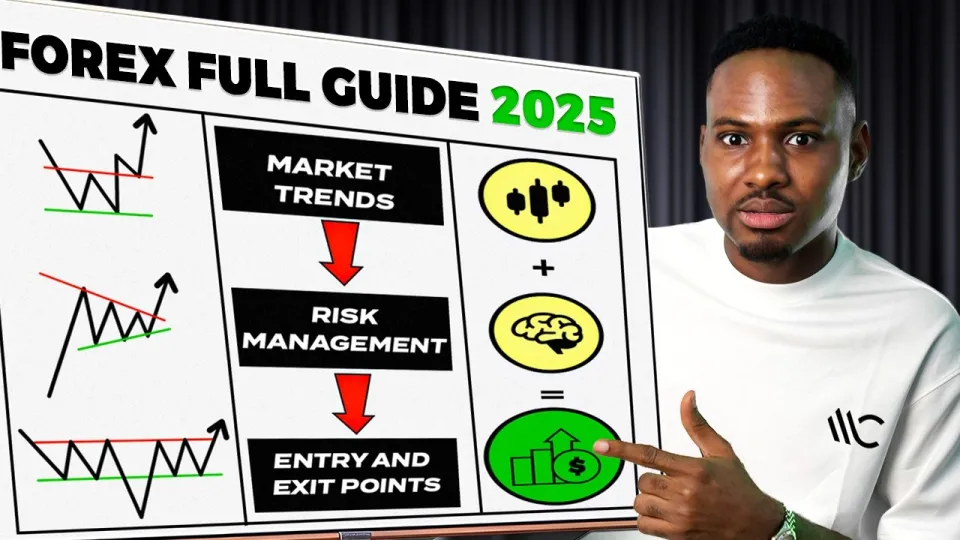
Video: How To Start Forex Trading For Beginners’ 2025 (Full Course)
You can order the same kind of articles for your own video to boost it on YouTube and Google. Just message the Telegram bot @sat_sit_bot. The bot writes and publishes the articles itself (with your YouTube video embedded) on popular topical websites (no ads). Your first 50 articles are free.
· based on the channel Jeffrey Benson Forex
Key takeaways
- Forex is an over-the-counter market where currencies are traded in pairs 24 hours a day, five days a week.
- Four sessions — Sydney, Tokyo, London and New York — overlap and create the liquidity peaks beginners should trade around.
- A working setup needs a regulated broker, MetaTrader 5, a demo account, a trading journal and a written risk plan.
- Risking 1–2% of account equity per trade keeps a normal losing streak from wiping out the balance.
- Most beginner losses come from oversized positions, no stop loss and revenge trading after a loss.
Forex trading for beginners starts with three things: understanding that you are trading currency pairs on an over-the-counter market, opening a demo account with a regulated broker and running MetaTrader 5, and defining in writing how much you are willing to lose on a single trade before you place it. Everything else — strategy, entries, indicators — is built on top of that foundation. A structured walkthrough of the whole path is what the free full course from Jeffrey Benson Forex covers, and the paid student track sits behind the Fire Pips FX plans page.
What forex actually is and why currencies are always quoted in pairs
Forex is the market where one currency is priced in another, so every quote is a ratio between two economies rather than a price in dollars. When you see EUR/USD at 1.0850, the euro is the base currency and the US dollar is the quote currency: one euro costs 1.0850 dollars. Buying the pair means you expect the base to strengthen against the quote; selling means the opposite. There is no central exchange — trades route through a network of banks, brokers and liquidity providers, which is why it is called an over-the-counter market.
Three consequences follow from that structure and matter more than any indicator:
- The market never closes on weekdays. It runs from the Sydney open on Monday to the New York close on Friday, so a position left open overnight carries swap costs and gap risk.
- Leverage is built in. A broker may offer 1:100 or more, meaning a small deposit controls a large notional position — the source of both the appeal and most beginner blowups.
- Spreads are your entry cost. The difference between bid and ask is how brokers earn, and it widens sharply around news releases and at session handovers.
Currency moves are driven by interest rates, inflation data, central bank decisions, employment figures and risk sentiment. A beginner does not need to forecast any of that; they need to know when volatility arrives so they are not caught in it accidentally.
How the trading day is structured across the four sessions
The forex day is a relay of four sessions, and the clock decides how much movement a pair is likely to deliver. Sydney opens the week, Tokyo follows, then London, then New York. The London–New York overlap is the deepest liquidity window of the day, which is why major pairs such as EUR/USD and GBP/USD tend to produce their cleanest ranges there.
A practical beginner schedule looks like this: pick one or two pairs, pick one session, and trade only inside it for the first few months. Trading the Tokyo session on a European pair, then jumping to New York on a commodity currency, is how new traders end up with no data about their own performance. Note the session times in your own time zone once and keep them in your trading notebook — the reference point stays fixed even when daylight saving shifts the open by an hour.
The tools and account setup a beginner needs before the first trade
The minimum viable setup is a regulated broker account, MetaTrader 5, a demo login and a journal, and none of it costs money to start. MetaTrader 5 is the standard platform for order execution, charting and backtesting; the broker you register with supplies the login that links the platform to live or demo pricing. Jeffrey Benson Forex recommends Assex Markets in his material, with a registration link at https://my.assexmarkets.com/auth/register?partner_code=1699134 and a separate walkthrough video on linking the broker account to MT5.
Work through the setup in this order:
- Choose the broker on regulation and costs, not bonuses. Check the licence, the spread on your intended pair and the minimum deposit.
- Install MetaTrader 5 and log into a demo account first. Place at least 30–50 trades on demo before any real money moves.
- Build a chart template you can read at a glance. One higher timeframe for direction, one lower timeframe for entry, and no more than two indicators.
- Start a journal from trade one. Date, pair, session, reason for entry, risk in percent, result, and one line on what you would repeat.
- Fund small. The first live deposit should be an amount whose loss would not change your life, because the first month is tuition, not income.
A notebook or spreadsheet matters more than most beginners expect. Writing the rules down while learning is what turns a video into a repeatable process, and it is the only way to tell later whether a losing month was bad execution or a bad strategy.
How risk management decides whether an account survives
Position sizing is the single variable that separates traders who last from traders who quit, because a strategy with a positive edge still destroys an account when each bet is too large. The standard rule is to risk 1–2% of equity per trade, calculated from the stop-loss distance rather than picked at random. If an account holds $1,000 and the rule is 1%, the maximum loss on any trade is $10 — the lot size is then derived from how far the stop sits from entry.
Three habits enforce that rule mechanically:
- Set the stop loss before the entry, never after the position is open and losing.
- Cap daily and weekly loss, for example 3% per day and 6% per week, then close the platform when the limit is hit.
- Fix a reward-to-risk target so a 40% win rate can still be profitable; at 1:2, two winners out of five trades break even before costs.
Drawdown maths is unforgiving: a 50% loss requires a 100% gain to recover. That asymmetry, not the entry signal, is why experienced traders talk about survival first and profit second.
Placing a first trade and reading the chart without overcomplicating it
A first trade should be a simple, rule-based one on a major pair during a liquid session, executed with a stop loss and a take profit already defined. The mechanics are the same on any platform: select the pair, choose market or pending order, set volume from your risk calculation, attach stop loss and take profit, then confirm. What separates a trade from a gamble is that the reason for entry was written down before the click.
A workable beginner framework is trend plus level plus trigger. Identify direction on a higher timeframe, mark the horizontal level where price previously reacted, and wait for a trigger — a rejection candle, a break and retest — inside your chosen session. If the setup does not appear, there is no trade; sitting out is a position too. Log the outcome either way, because the journal is what converts screen time into pattern recognition.
Common beginner mistakes and the questions new traders keep asking
The mistakes that cost beginners the most money are behavioural, not analytical, and they repeat across almost every new account. Oversized lots on the first live trades, moving a stop loss to avoid taking a loss, adding to a loser, and revenge trading immediately after a loss account for a large share of blown deposits. A second cluster is informational: jumping between strategies every week, trading five pairs in three sessions, and copying signals without understanding the risk behind them.
Signal copying deserves its own warning. Following calls from a channel — Jeffrey Benson Forex runs a free daily signal channel at https://t.me/firepipsignals and a premium group reached through https://t.me/jeffreybenzhelpbot — only works if you size the position yourself and know where the trade is invalidated. Copied trades without your own risk limits simply export someone else's risk tolerance onto your balance.
Useful links from the course
- Fire Pips FX student plans — the paid mentorship and course track.
- Free daily signal channel — one free trade idea per day.
- Assex Markets registration — the broker recommended in the course.
- Premium signal group access — subscription bot for the paid group.
The bottom line for anyone starting out in forex
Forex rewards preparation long before it rewards prediction, and the sequence that works is unglamorous: learn how pairs and sessions behave, set up a regulated broker and MetaTrader 5, trade a demo account with a written plan, and risk a small fixed percentage once real money is involved. The free full course from the Jeffrey Benson Forex channel is a genuinely complete starting point because it treats risk management as the core subject rather than an afterthought. Work through it with a notebook open, then prove the rules on demo before funding anything. When you are ready for structured mentorship, start at the Fire Pips FX plans page.
Source: How To Start Forex Trading For Beginners’ 2025 (Full Course) · Markdown version
Questions & answers
How much money do I need to start forex trading?
You can open a live account with a few hundred dollars at many brokers, but the amount matters less than the risk rule attached to it. What counts is that 1–2% of the balance is a loss you can absorb repeatedly without changing your behaviour, so a small account should trade small lots rather than stretch leverage.
Can I learn forex trading for free?
Yes. Platform access, demo accounts, charting and a large amount of structured education cost nothing, and the full beginner course from Jeffrey Benson Forex is free to watch. The paid parts — mentorship, premium signals — are optional acceleration, not a prerequisite.
How long does it take before forex trading becomes profitable?
There is no fixed timeline, but the realistic path runs through months of demo trading and journalling before consistent results appear. Traders who rush to live money usually spend that time instead on recovering losses, which is slower than learning the process properly first.
Is copying signals a good way to start trading forex?
Signals can help you observe how a setup is structured, but copying without your own position sizing and stop-loss rules transfers someone else's risk onto your account. Use them as study material alongside a demo journal, and only follow them live once you can explain why the trade is invalidated.